Approach
Where clinical judgment meets systems engineering — medicine practiced with an engineer's toolbox.
Physician
Practicing inpatient medicine in Duluth.
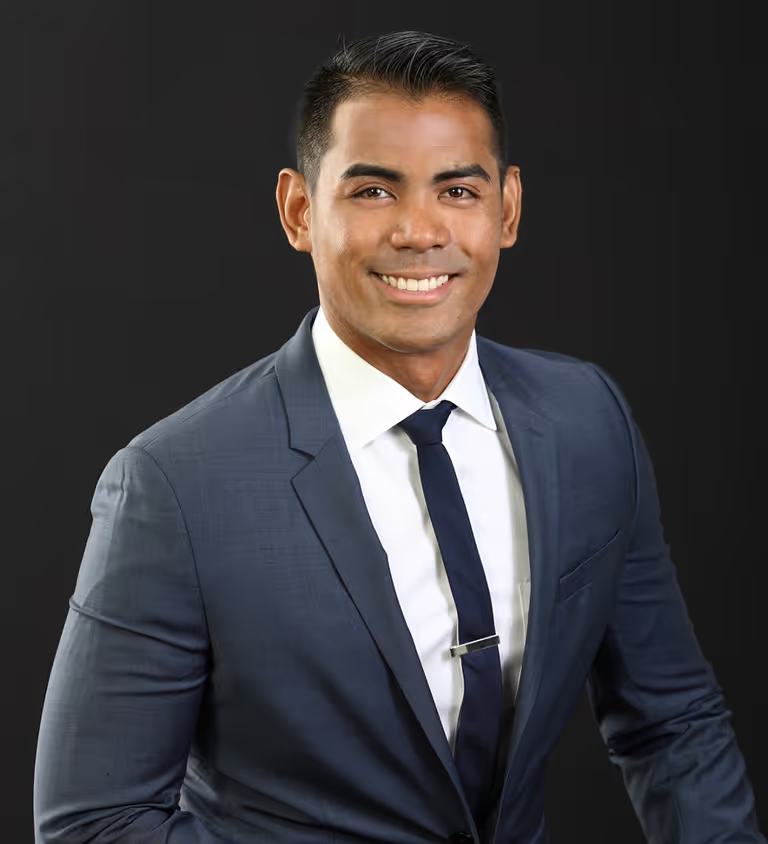
I am a hospitalist at Essentia Health-St. Mary's Medical Center in Duluth, Minnesota. My day is unglamorous in the way good clinical work usually is: morning rounds, family meetings, discharges that hinge on whether the pharmacy got prior authorization, a code that interrupts lunch, an afternoon spent untangling a patient who is medically ready but socially not. I write notes. I call consults. I argue with insurance. I sit at the bedside when someone is dying.
I am board-certified in Family Medicine by the American Board of Family Medicine and licensed in Minnesota (#77319) and North Dakota (#21451). My NPI is 1629645569. Between medical school and residency I spent six years at the bedside as a critical-care, trauma, ED, and acute-dialysis registered nurse (2015–2021) across Level I and Level II centers in the Phoenix metropolitan area. That is where I learned that the most important conversations in medicine happen at 3 a.m. with one chair pulled up to the bed.
Training
- Altru Family Medicine Residency, Grand Forks, North Dakota — ACGME-accredited, 36 months (2021–2024).
- Medical degree from University of the East Ramon Magsaysay Memorial Medical Center, Quezon City, Philippines (2011–2015).
- Bachelor of Science in Nursing, University of Santo Tomas, Manila, Philippines (2007–2011).
- Six years of bedside nursing across critical care, trauma, ED, and acute dialysis at Level I and Level II centers (Phoenix metropolitan area, 2015–2021), held between medical school and residency.
What I write about
The notes on this site are short essays on clinical AI, hospital medicine, and how to teach the body to patients in a way they can actually understand. The case studies are longer-form pieces on the specific technologies I have evaluated for use in my own practice.
My posture toward AI in medicine is neither evangelist nor refusenik. I use clinical decision support that has been validated in populations that look like the patients I care for. I do not use ambient scribes at the bedside. As a personal interest I curate a small index of existing, studio-made 3D patient-education visualizations, because that is the use of AI with a real chance of improving the conversation between a doctor and a patient about a serious diagnosis. These positions are my own and do not represent Essentia Health or any other institution.
Outside the hospital
I read a lot and run when the Minnesota winter cooperates. I grew up speaking English, Tagalog, and Chavacano, and get by in conversational Spanish. After hours I tinker with software and AI — a hobby I write about in the Builder section below.
Get in touch
To say hello — for collaboration, speaking, or just to connect — the contact page is the place. For everything else, the RSS feed is the right way to stay current.
Builder
A physician who codes — after hours.
Away from the hospital I am a hobbyist programmer. This is personal tinkering — nights-and-weekends experiments in AI, automation, and software — not a business, not a clinical service, and not a medical product. It is how I keep learning, the way other people garden or restore cars.
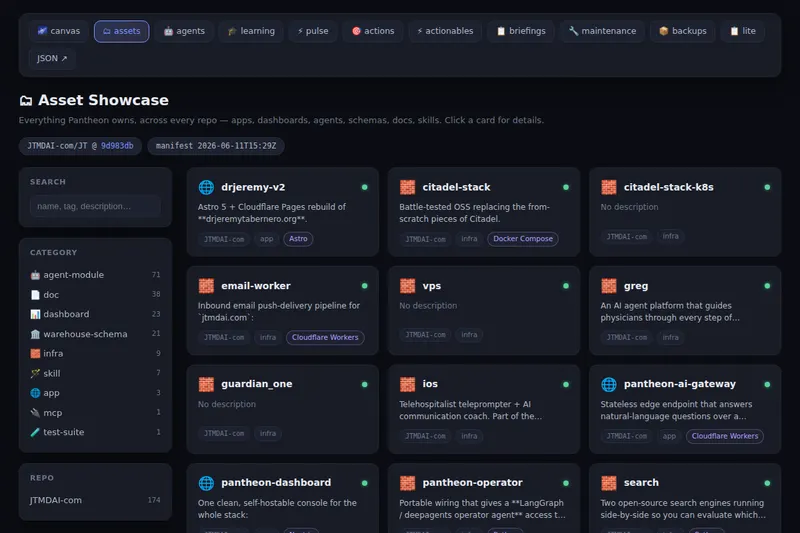
JTMDAI (JTMDAI Development Group LLC) is the personal lab where these experiments live — a homepage for the things I build for myself.
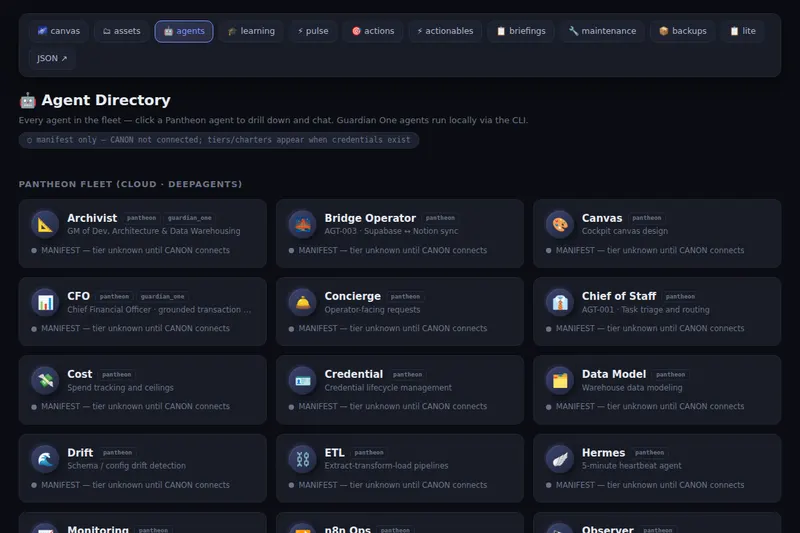
Guardian One is a multi-agent system I build to run my own life — finance, scheduling, security, and smart-home tasks coordinated under one encrypted, audited setup. It manages my data, not anyone else's.
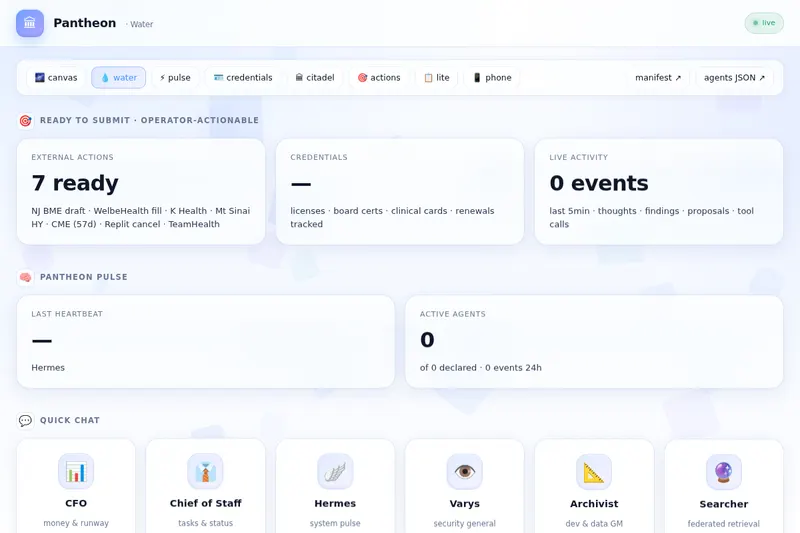
Project Pantheon is my autonomous-agent hobby project — an experiment in explainable decisions, reversible actions, and agents that learn from their own mistakes.
The habits carry over from clinical work — validated before relied on, explainable, reversible — but the goal here is curiosity, not a product. Nothing in this hobby is a medical or clinical service.